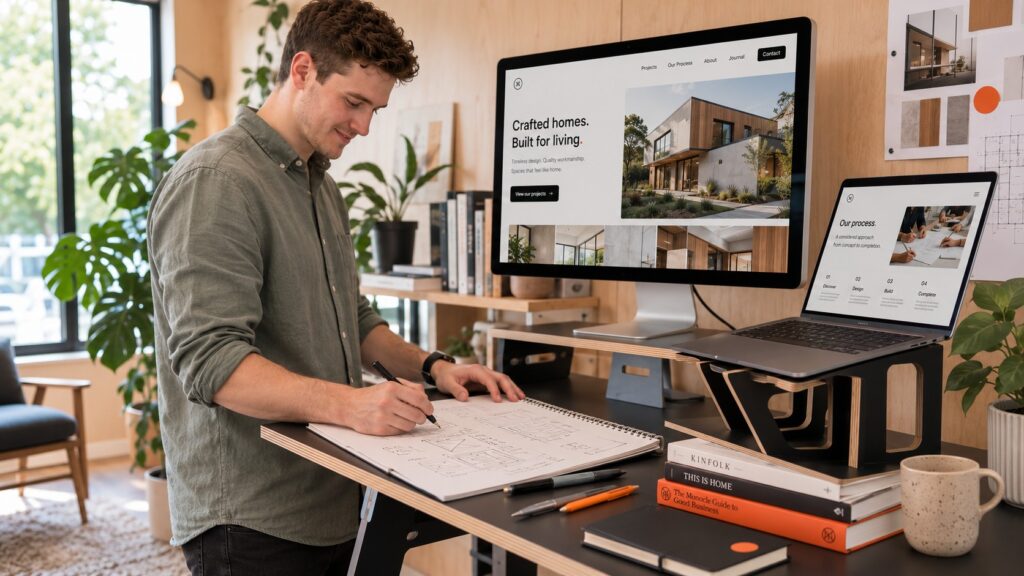
You’ve seen and used hundreds of websites. A clean homepage, an intuitive navigation menu and buttons just where you need them. What you don’t see is everything that happened before launch day.
The meetings, questions, brainstorms and rounds of feedback that go into a website. Every piece of copy and every element’s placement is intentional.
Most agencies keep that part behind the curtain. We’d rather show it off.
So here it is. The full Orange process, from the first meeting to the finished site, including every point where we check in with you along the way. Because a website that works isn’t something we make for you. It’s something we make with you.
First meeting: it starts with a conversation.
Our first meeting is all about getting to know each other. You’ll meet the core team who’ll be handling your project. The people you’ll actually be talking to, not a salesperson who vanishes once the paperwork is signed.
Then we listen.
What isn’t working? What made you reach out? Sometimes the answer is obvious. Sometimes “we need a new website” turns out to mean “nobody can find our pricing page.”
Our job at this stage is to understand the problem before we start talking solutions. Once we have a clear picture, we map out the scope of the project and come back to you with a quote. No guesswork. No surprises later.
Discovery call: then we dig a little deeper.
With introductions out of the way, we move into a discovery call. This is where we get to the root of the problem.
Maybe conversions are low or traffic to your site has stalled. Maybe the information architecture has grown so tangled that visitors give up before they find what they came for. Or maybe the site just looks like it was built a decade ago, because it was.
Discovery is a genuinely collaborative stage. You know your business and your customers better than anyone. We know websites. This is where those two things meet in a partnership. We brainstorm together, make recommendations and work towards a solution that fits.
By the end of it, we’ve locked in the timeline, the expectations and the scope. Everyone walks away knowing what we’re building, why we’re building it and when it will be ready.
Phase 1: setting the creative direction
Here’s where a lot of agencies disappear for six weeks and come back with a finished website you’ve never seen before.
We don’t do that.
Instead, we start with the pages that matter most. Phase 1 establishes the creative direction and concept, giving you a solid feel for how the whole project will come together. Typically that means the homepage, the navigation, any branding elements and a handful of key pages. Every client is different, so this shifts from project to project.
The goal is simple. Align on a creative vision and make the structural changes that tackle the core problem we uncovered in discovery.
Then it comes to you.
You review it, you give us your feedback, and we implement those changes before we move on to the next stage. It’s a lot easier to change direction on five pages than fifty. That’s how we get it right the first time, rather than the third.
Rollout: where the website comes to life
With Phase 1 signed off, we roll out the designs across the remaining pages. This is the point where it stops feeling like a concept and starts feeling like your website.
Any feedback from Phase 1 is carried through every page, so the whole site stays consistent. We also optimise every layout for different screen sizes and design dedicated mobile versions. Mobile isn’t an afterthought for us. A big share of your visitors will meet your brand on a phone first, and those mobile designs give our developers a clear blueprint when it’s time to build.
Quality assurance (QA): design & development get together.
This is the step clients rarely see, and it’s one of the most important.
Before anything is built, our designers sit down with our development team and walk through the project in detail. Custom blocks, interactive elements and animations. Where every button goes, how each form behaves and when a pop-up should appear.
It also gives the developers a heads-up on the timeline, so they can organise their team around your project. Every question answered here is a problem that doesn’t happen later. It keeps us aligned internally, which keeps your project running smoothly.
Development: building exactly what you approved
Once you’ve given final sign-off on the design, it’s handed over to development and the build begins.
At this point, the design is locked. That’s deliberate. Moving the goalposts mid-build is how projects blow out on time and budget. And because you’ve been involved at every stage so far, there shouldn’t be anything left to change.
Once the site is built, our design team does a final pass. We compare the live build against the approved designs, iron out any details that have drifted and check that everything works exactly as it should. If it doesn’t match what you signed off on, it doesn’t go live.
Content refinement: handing over the keys
Now the site is fully yours.
You’ll get access to add your final content and upload your images, and we’ll take care of the data merge, bringing your existing content across into the new site. This is the time to double-check all your copy and images, so everything is ready to go live.
You won’t be doing it alone. We’re still here if you need a hand.
Launch day (& beyond)
Once everything is finalised, the site is ready to publish.
Launch isn’t necessarily goodbye, either. Depending on your agreement, we can stay on for maintenance and ongoing support, keeping your site secure, up to date and performing long after the go-live date.
Why we work this way
You might have noticed a pattern. At almost every stage, there’s a point where we stop and check in with you.
That’s the whole idea.
Building a website in stages, with multiple rounds of feedback and QA built in, means nobody is surprised at the end. You’re never handed a finished product and asked to like it. You’ve shaped it all the way through. It’s how we get it right the first time. And it’s why we think of our clients as partners, not projects.
So the next time you land on a website that just works, remember there’s probably a whole process sitting behind it. Ours just happens to have a lot more conversations in it.